Not a generic dataset layer. A large-scale Vector-Positioned Reference Architecture.

Protected by core patents including RRI and RBQF, with an expanding pipeline of 20+ additional patent filings.
Built on major reference pillars including Facing Fears and Paris in Light, ARTANI’s reference architecture supports trust, validation, and pre-execution judgment.
ARTANI systems are built on a Vector-Positioned Reference Architecture designed to model human experience as structure, trajectory, and coordinate logic — not as flat data.
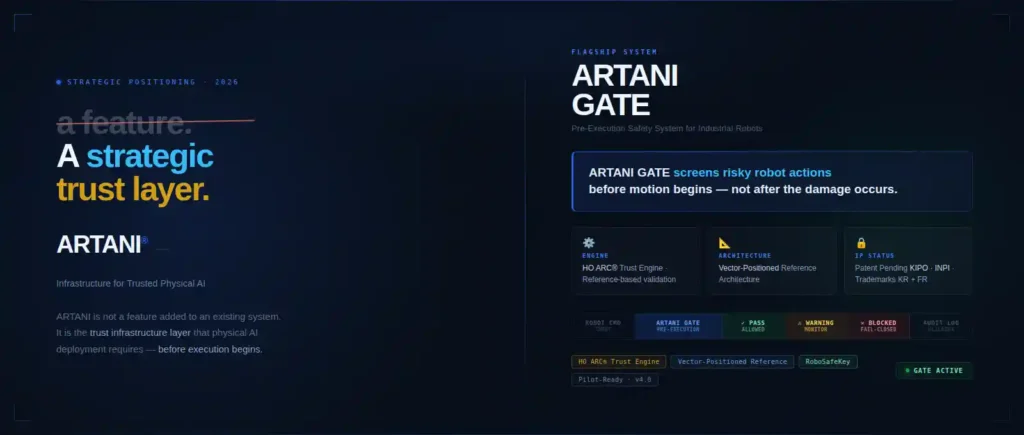
This is not a generic dataset layer.
It is not a conventional content archive.
It is not a replaceable collection of samples.
ARTANI’s reference foundation is a structured experience reference architecture built through two complementary corpora:
- Facing Fears (FF) — internal human state trajectories
- Paris in Light (PL) — environmental sensory transition fields
Together, they form a reference system for trust, validation, and pre-execution decision frameworks across ARTANI systems.
Facing Fears and Paris in Light, which underpin ARTANI’s Vector-Positioned Reference Architecture, have been deposited with the Bibliothèque nationale de France (BnF) under legal deposit. This supports archival traceability and proof of prior existence of the reference corpora.
NOT A DATASET. A REFERENCE INFRASTRUCTURE.
Traditional datasets usually function as:
- training datasets
- evaluation datasets
- synthetic datasets
ARTANI belongs to a different category.
It functions as a reference infrastructure.
Its role is not simply to train models.
Its role is to provide a structured reference layer against which AI systems can be interpreted, aligned, and validated.
That distinction matters.
A training dataset helps models learn.
A reference infrastructure helps systems judge whether behavior, state, or action should be trusted.
That is why ARTANI’s corpus has a fundamentally different industrial meaning.
DUAL CORPUS ARCHITECTURE
ARTANI’s reference foundation is built on two independent but complementary corpora.
Facing Fears (FF)
A corpus modeling internal human experience trajectories, including:
- emotion
- somatic tension
- cognition
- micro-movement dynamics
Paris in Light (PL)
A corpus modeling environmental sensory transitions, including 6 essential elements
Together, FF and PL define a broader structure:
Experience State = f (Internal State, Environmental State)
This is not a simple content pairing.
It is a dual reference architecture that links inner human state and outer sensory field into one coordinated system.
That is one of the deepest differences between ARTANI and conventional AI datasets.
HUMAN EXPERIENCE AS A COORDINATE SYSTEM
ARTANI’s corpus is not built around isolated samples.
It is built around a human experience coordinate system.
Facing Fears models the internal domain.
Paris in Light models the environmental domain.
Together, they create a structured reference environment in which AI systems can compare state, trajectory, context, and coherence against human-centered experience coordinates.
This is why ARTANI should not be understood as “content.”
It is a reference system for alignment and validation.
TRAJECTORY ENCODING, NOT STATIC SAMPLES
Each ARTANI episode encodes a trajectory of state change rather than a static sample.
This matters because static datasets capture moments.
Trajectory architectures capture change over time.
That gives ARTANI a much stronger structural basis for validation.
It allows AI systems to be compared not only against snapshots, but against structured human experience trajectories.
That is a fundamentally deeper form of reference.
LARGE-SCALE STRUCTURAL COHERENCE
The ARTANI corpus is not important merely because it is large.
It is important because it is large and structurally coherent.
Current corpus scale includes:
- Facing Fears: 300 structured episodes
- Paris in Light: 115 structured episodes
- Total: 415 structured experience episodes
But scale alone is not the differentiator.
The real differentiator is that these episodes are built within:
- a consistent conceptual framework
- a unified structural architecture
- a trajectory-based modeling logic
- a machine-readable schema layer
- a single-author developmental continuity
That combination is rare.
The architecture is difficult to substitute not because it is merely large, but because it is large, coherent, and internally continuous.
SINGLE-AUTHOR CONTINUITY
One of the strongest differences in ARTANI’s reference layer is authorship continuity.
The corpus was created under:
- a consistent conceptual framework
- a uniform structural design
- long-term narrative continuity
- persistent reference logic over time
That means ARTANI is not a patchwork of externally assembled samples.
It is a unified architecture that reflects a long-term, internally consistent developmental trajectory.
This matters strategically.
Algorithms can often be reimplemented.
Generic datasets can often be replaced.
But a long-horizon, single-author experiential architecture with structural coherence is much harder to reproduce.
That is part of why ARTANI should be understood as non-replicable experiential intellectual property.
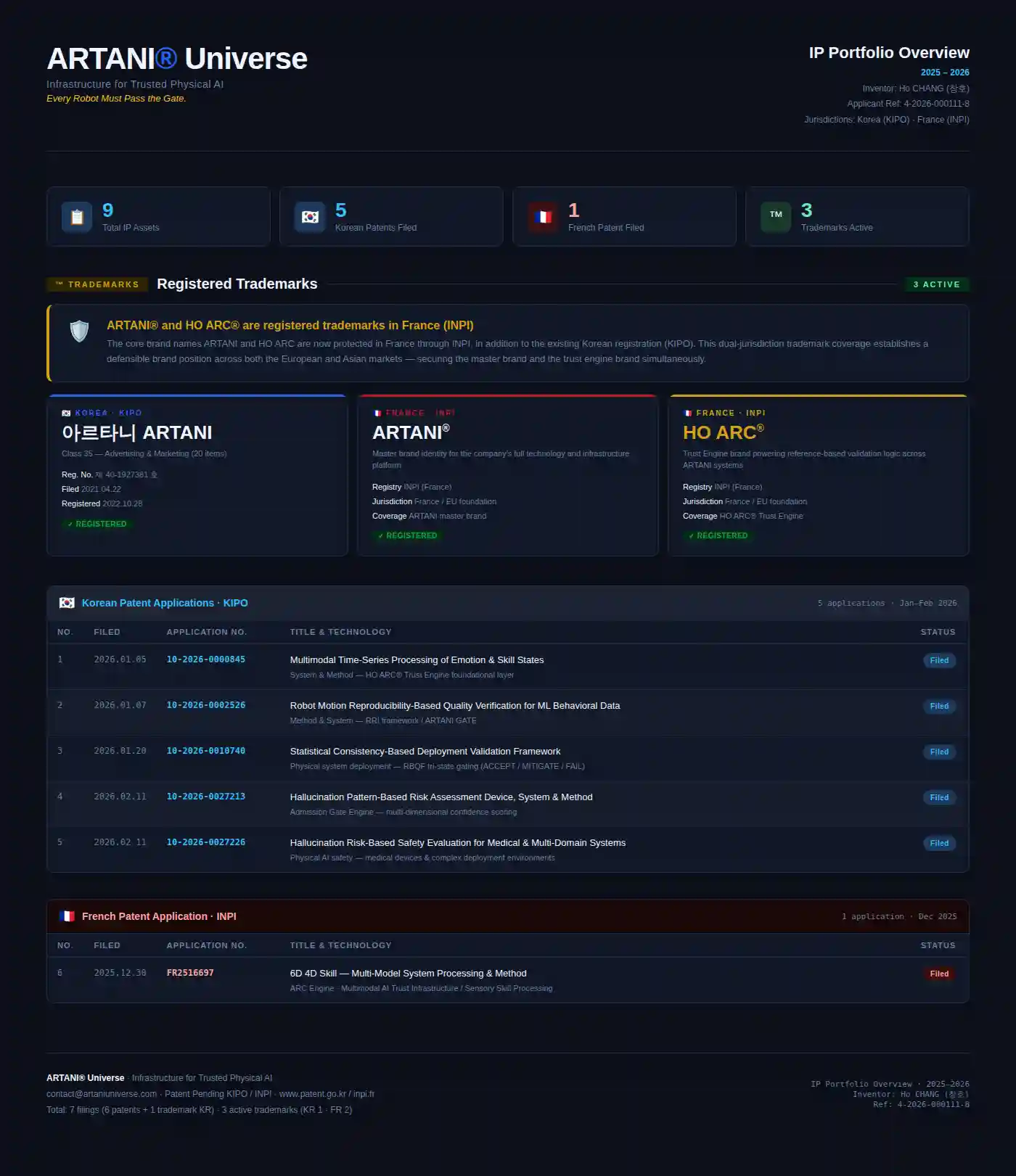
Protected as part of a broader system
ARTANI’s reference architecture is part of a broader protected system supported by patent filings and trademark assets across Korea and France.
[Insert Image: ARTANI_IP_Portfolio_new_cut (1).jpg]
Caption
Selected IP assets supporting ARTANI’s broader architecture for trust, validation, and physical AI.
WHY THIS IS INDUSTRIALLY IMPORTANT
As AI systems move into the physical world, the problem is no longer just prediction.
The problem becomes alignment between machine state and human experience.
That is where ARTANI becomes different.
Its corpus can function as a reference layer for:
- AI alignment validation
- human-AI interaction safety
- robot behavior evaluation
- environmental perception modeling
- pre-execution trust frameworks
In that sense, ARTANI is not only a dataset provider.
It is building a reference layer for physical AI and robotics validation.
REFERENCE LAYER FOR VALIDATION SYSTEMS
ARTANI’s corpus is designed to support validation frameworks such as:
- Admission Gate
- RRI
- RBQF
In those systems, the corpus functions as a reference coordinate library.
That phrase matters.
It means ARTANI is not just supplying data.
It is supplying the structured reference coordinates against which systems can be judged.
This is a much higher-value position than ordinary dataset usage.
WHY ARTANI GATE HAS MORE DEPTH
ARTANI GATE is stronger because it is not standing on a shallow base.
Its visible outputs — PASS / WARNING / FAIL — are only the surface layer.
Behind those outputs sits a deeper system that includes:
- HO ARC® as the trust engine
- FF / PL as a dual reference architecture
- trajectory encoding
- event marker logic
- machine-readable experience objects
- a large-scale reference coordinate system
That is why ARTANI GATE is not just a dashboard, alert layer, or threshold filter.
Its judgments are supported by a structured reference environment with far more depth than conventional monitoring systems.
WHY THIS IS HARD TO REPLACE
Most datasets are replaceable because they are statistical collections.
ARTANI is different.
Its value is tied to:
- dual internal / external modeling
- trajectory-based encoding
- event marker architecture
- machine-readable schema structure
- long-term conceptual continuity
- large-scale structural coherence
That combination makes the architecture difficult to recreate, difficult to substitute, and difficult to reduce to commodity data.
This is not just a reference collection.
It is a reference architecture with structural rarity.
NOT JUST DATA. NOT JUST CONTENT. NOT JUST SCALE.
Paris in Light and Facing Fears are not ordinary datasets.
They are not just large collections.
They are not simply narrative assets.
They are the two major pillars of ARTANI’s Vector-Positioned Reference Architecture — a structured experiential foundation designed to support trust, validation, alignment, and pre-execution decision systems for physical AI.
Their value is not descriptive.
Their value is architectural.
WHY THIS MATTERS NOW
As robotics, autonomous systems, and physical AI expand into human environments, systems need more than thresholds and alerts.
They need reference structures capable of supporting:
- alignment
- interpretation
- validation
- trust before motion
- coherence between machine behavior and human context
ARTANI’s reference architecture is built for that problem.
It helps transform reference from passive data into active infrastructure.
ARTANI® and HO ARC® are registered trademarks in France and Korea.
Facing Fears
ARTANI® and HO ARC® are registered trademarks in France and Korea and are assets of ARTANI Universe.
Facing Fears is a foundational reference dataset within the ARTANI Reference Foundation. It defines internal state structure, reference trajectories, and deterministic coordinates used before execution.
Paris in Light
ARTANI® and HO ARC® are registered trademarks in France and Korea and are assets of ARTANI Universe.
Paris in Light is a contextual adjudication reference dataset within the ARTANI Reference Foundation. It defines contextual admissibility and environmental reference conditions through vector-positioned reference units.
CLOSING
ARTANI is building infrastructure for trusted physical AI.
Its Vector-Positioned Reference Architecture is not a background dataset layer — it is a large-scale experience reference infrastructure designed to support trust, validation, and pre-execution judgment in the physical world.
© 2000-2026 ARTANI Universe. All rights reserved